|
||||||||||||||
|

|
|||||||||||||
|
||||||||||||||
|
||||||||||||||
|
||||||||||||||||||||||||||||||||||
Do GSD's make good family pets?
A well bred and properly trained German shepherd makes a wonderful
family companion. They are naturally protective of their "pack".
As with any other breed, young children should never be left
unattended with a puppy, however, if the children learn to
respect the puppy as a living being, the puppy will be a wonderful
companion for the children as they all grow up together. Your
dog's ranking in the "pack" should always be established
as the bottom (Omega) member below humans.
What traits are present in the German Shepherd?
The breed is naturally loyal, intelligent and protective (which
makes it good for police work). The GSD has an excellent nose,
making it good for tracking and search and rescue work. They
are calm and have a steady temperament when well-bred which
is why they have been used as "Seeing Eye" dogs.
A GSD thrives on regular exercise, mental stimulation and
a well-balanced diet.
They are very trainable and love to work. The German shepherd
is affectionate but generally not dependent. He is aloof to
strangers and may often seem quite indifferent to those outside
his 'pack'.
Breeding plays an important role in the temperament of GSD's, therefore selecting a reputable breeder concerned with both physical health and the personality of their puppies is of utmost importance. Different bloodlines exhibit traits differently, so question breeders about the strong and weak traits of their bloodlines. See the article on German versus American bloodlines about specific general differences.
Can you guarantee my puppy will not have hip problems?
We offer a two year guarantee for moderate to severe hip and/or elbow dysplasia. We do not ask that you return your puppy or have him/her put to sleep.
No breeder in the world can guarantee that the puppies won't
develop dysplasia, and if they do... beware.
Hip dysplasia is considered to be polygenic and is also influenced
by environmental factors. That means that it's caused by
a combination
of genes that may not show up in any litter previously. No
matter the certifications in the pedigree it is possible
that your puppy could be predisposed to hip dysplasia. Treatments
(both surgical and drug) can be done early to alleviate problems
down the line. If in doubt, find an orthopedic specialist.
Be wary of a breeder that says their puppies will definitely
not have hip problems.
The parents of our puppies are certified free
of dysplasia and that should your pup develop a problem,
I will be available to help and guide you in deciding what
steps to take.
What is the difference between males and females?
Some people will say that males are more "location"
protective while females are more "pack" protective.
Males are generally more territorial, so unless training
steps are consistent, marking could be a problem. (Neutering
may help alleviate this problem. Any dog not intended for
a breeding program should be neutered or spayed. Besides
eliminating the possibility of unwanted puppies and reducing
some undesirable behaviors, it's considerably healthier for
your dog since it eliminates or severely reduces the chance
of testicular or mammary cancers. Breeding should *never*
be taken lightly. I have found that it is more useful to
look to the individual temperament and personality of each
pup in the litter then to generalize about sex differences.
How old will my puppy be when I take it home?
Puppies are old enough to go to their new homes by eight weeks.
How big will my German shepherd be?
The full adult size of your GSD will depend in large part
on the genetic background of its parents. Adult males
should range between 24-26" at the shoulder blade,
females from 22-24". Males within the standard may
weigh anywhere from 75-90 lbs. depending on their bloodlines.
Females may weigh anywhere from 55-75 lbs. Although your
pup will reach close to adult height by 10-18 months,
he will continue to fill out until up to 3 years old.
Be wary of breeders who emphasize "oversize", "huge",
"big-boned" breeding stock or puppies. Bigger
is not better in German Shepherds. The German Shepherd
is not built to have a skeletal and muscular structure of
an oversize breed. An inch or so out of standard may be acceptable
providing the general line is not consistently out of standard.
A responsible breeder will offset an oversize dog by breeding
with a line that is a bit smaller in order to maintain the
standards as closely as possible.
What is "socializing" and why is
it so important?
Socializing refers to exposing your puppy to a variety of
experiences, including meeting lots of people of various ages,
races, sizes and both sexes as well as teaching them how to
acceptably interact with other dogs. Puppy kindergarten classes
provide an excellent opportunity for socialization in a controlled
environment.
Socializing is important because it helps strengthen your
dog's confidence and reduces the chance that your dog will
become shy or fearful. Fearful dogs can become fear aggressive
or fear biters.
All our puppies interact daily with our young children
and experience playing inside and outside with the kids, older
dogs, cats and different people.
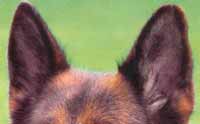
Will my German shepherd puppy's ears stand?
Although some puppies' ears stand as early as 8-10 weeks,
don't be concerned if your pup's ears don't stand until
6-7 months (especially pups with large ears) after teething.
Some pups ears never stand. This is known as a "soft
ear".
Sometimes taping is successful. "Soft ears" are
a genetic trait, and dogs with soft ears should not be bred
even if taping is successful. It is a disqualification in
showing but does not affect the dog' health in a negative
way.
What precautions should I take with my GSD
puppy?
Other than the normal precautions of immunizations beware
of a fast-growing puppy. There are studies that show a correlation
between fast growth and hip dysplasia (if your pup is predisposed
to HD). You may want to switch your puppy over to adult food
if it seems to be growing very quickly.
Don't pet your puppy's ears backwards before they stand. Although
people often do this by nature, it can damage the cartilage
in your pup's ears which can affect the ear carriage.
Do take your puppy to puppy kindergarten and obedience training classes and do your homework for these classes. Behaviors that are cute in a 15 pound puppy can be dangerous in a 75 pound adult. Socialize your puppy with people (especially children) and other dogs frequently (after your puppy has completed its immunization series sometime after 16 weeks old).
Your puppy may go through a period known as "adolescent shyness" when it reaches 4-5 months of age. This period can last until the pup is 12-18 months old. Socializing your puppy from an early age will help minimize this shyness. Expose your puppy to a variety of experiences, but do so gently. You don't want to traumatize your puppy.
Be careful of heavy physical exertion directly before and after eating, especially if your GSD is a "gulper". German shepherds and many other large breeds can suffer from bloat. If your dog's abdomen becomes distended and rigid and it can not seem to belch or pass gas, gastric torsion may be the problem. This is an immediate health concern and you should contact your vet or an emergency clinic.
How long should I wait to switch my puppy to adult food?
We recommend switching at around 12 weeks to a feeding a high
quality adult food. Check out the content of the food closely.
A puppy or dog with average activity should have about 26%
protein and 15-18% fat. Look for some kind of meat to be the
first ingredient, not a grain product.
Studies have shown that puppies growing quickly may be more
prone to developing hip and elbow dysplasia. Dry food is fine,
you don't need to supplement with canned food. It's expensive
and doesn't provide anything a good dry food doesn't. If your
puppy doesn't want to eat the dry food, you can moisten it
slightly with warm water. This may also reduce the risk of
bloat and don't worry, the pup will eat when he is hungry!
How often should I feed my puppy and how
much?
Feed the pup morning and evenings, as much as he will eat
in one sitting then remove the bowl until the next meal. Of
course you do need to keep an eye on your puppy's/dog's weight,
you should be able to feel the ribs under the skin fairly
easily. Adjust your portions appropriately if the puppy is
putting on excess weight.
Remove his water source several hours before bedtime and fresh water should be available with every meal. Once the dog is housebroken, free access to water unless you will be gone for an extraordinarily long period of time should not be a problem.
What is bloat (gastric torsion)?
Bloat (otherwise known as "gastric torsion") can
be a problem with any deep chested breed like German Shepherds.
The stomach twists so nothing can pass through the esophagus
to the stomach or through the stomach to the intestines, causing
gas to build up. This is an immediate health concern where
the dog should be taken to the vet or emergency clinic. Signs
of bloat include a distended rigid abdomen, indications of
vomiting with no results and inability to belch or pass gas.
High activity directly before or after eating can exacerbate
bloating. Keeping the dog quiet at least one hour before and
after eating can help reduce the chances of bloat. Pre-moistening
the dog's food with water can also reduce the chances and
smaller meals can also reduce the risk of bloat if you do
not free-feed. (Free-fed dogs just need to have their activity
level watched, but do not usually eat enough at any one sitting
to cause problems. Bloat is more of a problem with a dog that
"gulps" its food which a free-fed dog won't usually
do. Don't leave pre-moistened food down for a free-fed dog
too long as it can breed bacteria. Instead, leave them smaller
portions, but refill more frequently.)
What is the life expectancy of a German shepherd?
Most lines of GSD's will live to between 10-12 years of age.
11-12 years is probably a very reasonable expectation. A
GSD becomes "middle-aged" between 6-8 years old,
and is generally considered "geriatric" at about
10. Their food intake and exercise and nutrition needs may
change over this period of time. They may begin to develop
stiffness in their joints (much like people do as they get
older). Healthy teeth are important as bacteria from decaying
teeth can affect the health of the dog.
What is the difference between the American/Canadian and the European bloodlines?
Do German Shepherds shed a lot?
Yes. The GSD is a "double-coated" dog with
an undercoat and guard hairs. The guard hairs will be shed
all year. The undercoat is "blown" twice a year.
The shedding is pretty much constant, but a regular weekly
brushing keeps things under control. Avoid giving baths as it dries out the coat's natural oils.
What is a long-coated German shepherds?
The correct GSD coat is relatively short with an obvious undercoat.
As such it is quite waterproof. Some dogs are born with long
coats which usually, though not always, also have an undercoat.
The normal coat is dominant to the long version, so there
are three kinds of dog: normal, normal but carrying the long
coat gene, and long. About 10% of the pups are born long-coated.
If you don't intend to show your dog in conformation, there's
no reason to avoid the long-coated GSD. Long-coated GSD's
can and do compete in obedience and other working disciplines.
You should be aware, however, that the longer coat does require
more attention when grooming.
Are German shepherds smart and easy to train?
Yes and no to both. Most GSD's are eager and willing to learn
and enjoy training sessions (don't overdo with a young pup
- they just don't have the attention span). If you start young
and teach your puppy its order in your "pack", problems
with training will be minimized. However, GSD's tend to have
more dominant personalities than some breeds and can be stubborn,
so some care in training is recommended. Classes are extremely
beneficial. A GSD that thinks it's the Alpha member of the
pack can be a big handful.
We help you to select the puppy with the appropriate temperament for your living situation. This helps to insure that with proper training the relationship between your dog and your family will be harmonious.
My young GSD is limping! Is it pano or dysplasia??
You probably do want to take your pup into a vet just to make
sure you can eliminate hip and elbow dysplasia from the cause
of the problem. Most likely the vet will confirm that your
pup has panosteitis, an inflammation of the long bones in
the legs of adolescent pups. It's fairly common in GSD's It's
also known as "long bone disease", "shifting
leg lameness" and "growing pains". "Pano"
can be detected and diagnosed by x-ray.
Onset can be from 5-12 months (occasionally later) and last
until 18 months or more. Though it is uncomfortable for the
puppy, it almost always grows out of it. The lameness need
not be limited to one leg.
What is an average size litter?
An average size litter for a GSD is six to eight puppies.
What is the difference between a GSD and
an Alsatian?
There is no difference. After each of the World Wars, anything
German fell out of popular favor. To avoid the use of the
word German, "Alsatian" (from the Alsace-Lorraine
area) was used. In some countries, GSD's are still known as
Alsatians. The name in Germany is Deutsche Schaferhund which
means "German Shepherd Dog". The word "Dog"
is part of the name.
What is Schutzhund?
Schutzhund is German for "protection dog", but it
also refers to a training discipline and dog sport involving
3 phases; obedience, tracking and protection. It is supposed
to be a fun experience for both the dog and the handler. If
it isn't for one or the other, don't consider it. Find another
activity. Schutzhund is not the be all and end all of training.
See the section on Schutzhund (often noted as SchH) for more
information. (Also, as of this writing, a Schutzhund FAQ is
being worked on by some of the subscribers to the GSD-L mailing
list. See the Resources for information on GSD-L.)
Why buy from a reputable breeder?
You should seek out a reputable breeder when looking for a
GSD pup because of the health concerns noted above as well
as problems in temperament brought out in ill-bred GSD's Poorly-bred
GSD's can also be aggressive, fearful, or shy-sharp (a fearful
dog that becomes aggressive when frightened). It is for these
reasons that a reputable breeder is more likely to have sound
pups, guarantee their health, help you select the puppy most
suited to your lifestyle and goals, and be able to guide you
as the pup grows.